 Arunava about Football A look at football & the world through my eyes!
Related Articles
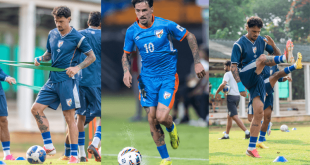


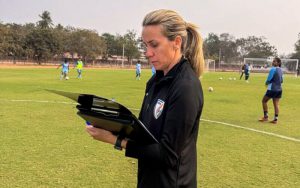 Pamela Conti, the new head coach of the Indian U17 women’s team, has lived and breathed football across the length and breadth of the world.
She was born in Palermo, the capital of Sicily, where football isn’t just a game, but an identity and a symbol of pride. It is also known for its strong grassroots culture.
Italy, Spain, Russia, Sweden, the United States, Venezuela, and now India. Conti’s journeywoman and laureated career has taken her to four different continents; 90 caps and 30 goals for the Italy national team, multiple league and cup titles for various clubs as a player, an U20 World Cup qualification, and a South American Games gold medal as Venezuela’s coach. From Palermo to the world, quite literally.
Football is also in the blood. Her father and two brothers all played for Palermo FC. Her brother Vincenzo, was her assistant coach in Venezuela, and will continue in that role in India.
Before departing for Nepal for the SAFF U19 Women’s Championship, her first tournament with the Young Tigresses, Conti spoke to the-aiff.com about taking on this new challenge, the importance of building a professional mindset within a young squad, her footballing philosophy that blends Italian and Spanish principles, and the tough task that awaits India in their return to the AFC U17 Women’s Asian Cup after 21 years.
Why and how did you decide to take up this new challenge with the Indian U17 women’s national team?
Pamela Conti: For me, this represents a new challenge, and an important one. Above all, it is an opportunity to help very young players understand what it truly means to develop a professional mentality. I want to introduce them to a new methodology, a mix of Spanish and Italian football culture. That kind of football really inspires me. I am very grateful to the Federation for trusting me with this group, and I am extremely proud to be here.
How have the first few days with the players been? What is the atmosphere like within the team?
PC: I feel very good. I have been treated exceptionally well and received with a great deal of respect. The players are happy, and we are gradually building connections. These are the first few days, so, normally, we are still getting to know each other. What I really like is how quickly the players are adapting to what we are asking of them on the pitch. Off the pitch as well, they are young girls, and it is important that they understand the rules and discipline required for football development.
How familiar were you with Indian women’s football before you accepted this role?
PC: Yes, I was familiar. I follow women’s football globally and try to understand how different countries are progressing. When I was coaching Venezuela, we played against India once, in 2021, in Brazil. We won 2-1. I wasn’t physically present because I had COVID at the time, but my brother (Vincenzo Conti, assistant coach) was there, and I watched the match from home. India scored first (via Grace Dangmei in the 18th minute), and then Venezuela made a comeback in the second half through Bárbara Olivieri (in the 81st minute).
That said, as a national team coach, it is important to understand football worldwide. India is a very large country with enormous potential. I hope a strong long-term programme is built to push women’s football forward, not just in India but everywhere. Women’s football needs more support globally. As a woman, I believe we deserve our space, and we can continue to grow.
Vincenzo Conti, your elder brother, has worked alongside you as an assistant coach across different teams. How important is his presence and support for you on the touchline?
PC: My brother is a part of me, perhaps the best part of me. He is much calmer than I am and has very clear ideas. I don’t have a father, so for me, he is also like a father figure, a brother, a friend. Everything. He is a former professional footballer who has taught me so much. He is my right hand, the person I trust the most in this world, both professionally and personally.
You bring a lot of experience from Europe and South America. What football philosophy do you want to implement with this team?
PC: We know how difficult it will be in the Asian Cup. There are extremely strong teams in Asia. We can talk about DPR Korea, who won both the U20 and U17 World Cups last time. There’s also Japan, China, and Australia. The competition is very intense in Asia.
Our first objective is discipline and changing the mindset from being a young player to becoming a professional. Hard work is essential. Philosophically, we want to create a mix of Italian tactical organisation, especially defensive structure, with Spanish football principles. I have lived in Spain for many years, so we work a lot on ball possession, transitions and counter-attacks.
The most important thing is teaching football fundamentals: order, balance, and understanding space on the pitch. These players are at the beginning of their journey, and it is our responsibility to teach them things they may not yet know.
Your first tournament with the Indian team is around the corner — the SAFF U19 Women’s Championship in Nepal. India will be taking part with the U17 squad. What are your objectives there?
PC: We will face teams that are two years older than us because it is an U19 tournament. For us, the priority is to give opportunities to all players so I can observe them closely. Of course, we always go to compete and to win, but we also understand the challenges we may face due to age differences. This experience will certainly help us in the future.
Looking ahead to the Asian Cup and World Cup qualification, what do you think are the key areas for improvement?
PC: First of all, organisation in defence and attack. We need a compact, well-organised team that does not give space to the opposition. Clarity of ideas is crucial. We need to lessen the space between the lines, especially midfield and defence. This takes time for players to adapt. Communication, compactness and quick transitions when we regain possession are the most important elements.
You had a long and successful playing career for various clubs and the Italian national team. What motivated you to become a coach?
PC: In my final playing years, I already felt that I wanted to coach. While playing, I often saw situations where I thought, ‘Why hasn’t this been explained?’ That’s when you realise your mind wants to teach.
I retired at 32 without injuries. I could have played many more years, but I knew my future was on the other side. I wanted to give opportunities to young boys and girls. I ran an academy in Palermo, and many players I coached there are now playing professionally. One was recently called up by Fiorentina, another signed for Genoa, and another plays for Juventus. Now they are all playing for professional teams, so for me it is a great source of pride to have done important work with them over four or five years, starting from when they were children and giving them a solid foundation.
Now they call me, and for me it is very special to be able to say, ‘Look, I’m going to give you my shirt.’ I am very grateful for that, because maintaining this contact and this beautiful, respectful relationship with these players is very important.”
You spent five years coaching Venezuela. How was that experience?
PC: I will always speak very positively about Venezuela. I am extremely grateful to President Jorge Giménez (of the Venezuelan Football Federation) because he always gave me opportunities and placed a great deal of trust in me. We share a very strong mutual respect. We worked very well with the entire federation. Venezuelan football has grown significantly since I arrived, and I have very beautiful memories. After five years, I believed it was right to bring that cycle to an end and look for a new challenge.
What has been the most memorable moment of your career, as a player and as a coach?
PC: As a player, it was scoring a penalty in the 90th minute while drawing a match — if I scored, we won the league. It was with my club Torres in Italy, and we won the title. I think there is a photo where the pitch was completely soaked, and the whole team was on top of me, celebrating. I still get goosebumps even now after 15 years. It is an unforgettable memory for me.
As a coach, qualifying for the U20 World Cup with Venezuela is the greatest moment of my life. Winning the gold medal at the South American Games in Paraguay in 2022, beating Uruguay on penalties, was also very special.
Lastly, what is your message to Indian football fans?
PC: The most important thing is their support and belief in our work, but also understanding the reality of where we are. We will work day and night to give our best. Please never doubt the commitment of the technical staff and, most importantly, the players. These are young girls representing a huge and beautiful country. They make significant sacrifices, living away from family for long periods, missing friends, and missing home. That is not easy. For that alone, they deserve respect and gratitude. We are all living away from our families. Football is a privilege, yes, but it also comes with sacrifice. Understanding that is very important.

