 Arunava about Football A look at football & the world through my eyes!
Related Articles


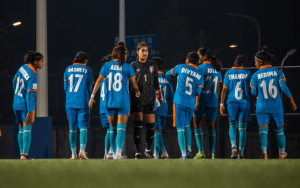 India’s return to the AFC U17 Women’s Asian Cup after 21 years began with a 0-2 defeat against Australia on Saturday, but the immediate post-match assessment from within the camp remained grounded in realism, with a clear focus on areas that need improvement ahead of the next challenge against Japan on Tuesday.
Head coach Pamela Conti acknowledged the difficulty of the contest against a physically dominant opponent while pointing out that the decisive moments came from within.
“It was a difficult match. We knew Australia had a lot of quality, and it was going to be hard to play with the ball,” she told the-aiff.com.
“I think the team did very well defensively. It was important not to concede many goals, and in the end, the two goals they scored came from our own mistakes. That is where we need to improve a lot,” the Italian said.
Australia’s opener in the first half and a second-half own goal proved decisive, but India’s structure largely held firm across long phases of the game. Conti emphasised that her tactical approach was not built around passive defending.
“In the second half, things changed because we attacked more. We already knew that when you open up against teams like this, they will score. I told them to stay as compact as possible, to play with a mid or high block, and to press. I didn’t want the team to just sit back and defend all the time. It’s unfortunate that we scored an own goal.”
Despite the result, she highlighted specific defensive positives, particularly in limiting Australia’s clear chances.
“I think there are many positives. First, Australia didn’t have many shots on target. We defended very well. All the players showed great desire and commitment. Now our focus shifts to Japan.”
There is also a broader awareness within the group about how fine the margins can be at this level. Just last month, India’s U20 side exited the Asian Cup group stage on goal difference despite finishing level on points with other third-placed teams, serving as a reminder that every goal scored and conceded can ultimately shape qualification scenarios.
India utilised their full bench during the match, with the five substitutions contributing to a more proactive second-half display. Conti remained measured in her evaluation.
“Yes, I’m very proud of my team. I think we played a great match. But we also have to be realistic. We are talking about Australia, a very strong team. We played well, but now we face Japan, which will probably be even more difficult. We also have to manage the players physically because it won’t be easy.”
Four hours before India’s game, Conti had made the short walk to Pitch 4 to watch Japan’s first half against Lebanon, which ended 7-0. By the time she made her way back to the hotel and finished her pre-game team meeting, the full-time score read 13-0 to the East Asians.
“I went to watch the first half of Japan’s match against Lebanon. They are an incredible team. I don’t think I’ve ever seen a team at this age play like that. We have to be very careful because it will be a long and demanding match. We will do video analysis of the mistakes we made and continue working towards the match against Japan,” said Conti.
From within the squad, midfielder Thandamoni Baskey, who played 89 minutes, echoed the sentiment that while the team showed discipline, key moments could have been handled better.
“This was our first match in the Asian Cup. I feel we did well, but we could have done even better. They didn’t manage to take many shots, and even the one they scored came from our mistake,” said Thandamoni, who was crucial in the qualifiers, with a goal and an assist.
Against a taller and more physical Australian side, India had prepared for specific match scenarios.
“The coach had given us clear instructions about our roles. They were taller than us, so we had to think about how to deal with that. Our mentality was to believe in ourselves and know that we can do it.”
While the result leaves India with work to do in the remaining group fixtures against Japan and Lebanon, the approach within the camp remains forward-looking.
“We still have two matches left, so we will keep working harder and try to win,” Thandamoni added. “There’s a bit of disappointment after the loss, but also a strong feeling from within that we must lift ourselves up.”
Anushka Kumari, who was introduced in the second half as India pushed forward, pointed to the need for greater attacking efficiency.
“We weren’t able to attack much, so we needed to create more attacking positions and keep more shots on target,” she said.
There was renewed vigour among the Young Tigresses in the second half. India produced two shots on target, compared to Australia’s none.
“As for the result, the match was very tough, but we gave our best. Our finishing wasn’t good. They were physically stronger than us, and that affected our game a little,” Anushka added.
India’s approach to countering Australia’s physicality involved keeping the ball on the ground and avoiding aerial duels.
“Our plan was to deal with their physicality. We knew that if we played long balls in the air, we wouldn’t be able to compete, so we focused more on playing on the ground. That would benefit us more.”
In the second half, India won more duels (19) than Australia (11).
With two group-stage matches remaining, India now turn their attention to the next fixture against Japan, where improvements in decision-making, execution, and control in key moments will be critical against one of the best sides in the world.
